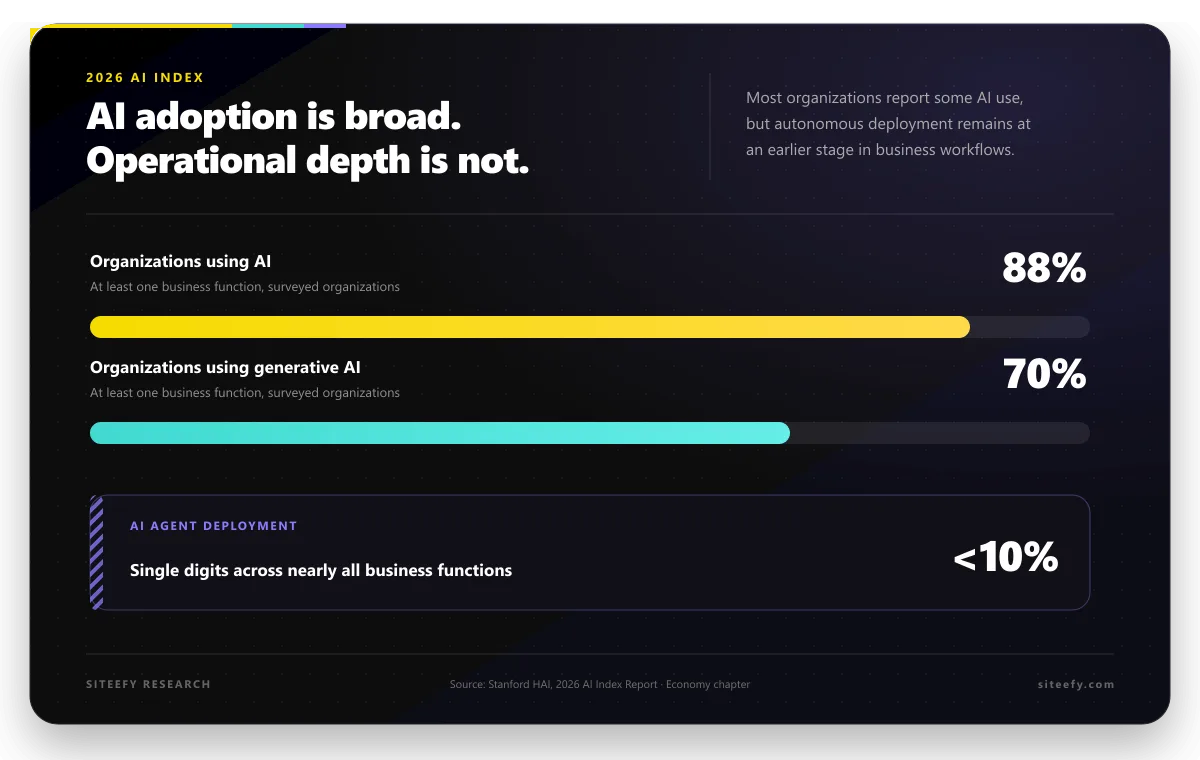
Artificial intelligence (AI) can transform businesses, boosting efficiency, innovation, and customer engagement in unprecedented ways. McKinsey’s latest report shows that 78 percent of organizations now use AI in at least one business function, highlighting how quickly it is becoming part of standard operations.
Yet adopting AI without proper preparation can still lead to wasted resources, missed opportunities, and even operational setbacks. This guide outlines what businesses should know before moving forward with AI so they can approach adoption with clarity and confidence
Key Areas Before AI Implementation
| Area | Key Considerations | Actionable Insight |
|---|---|---|
| Business Goals | Define clear AI objectives aligned with strategy | Identify 2–3 pain points AI can address immediately |
| Data Readiness | Evaluate data quality, accessibility, security, and infrastructure | Conduct data audits or engage AI consultants for readiness assessment |
| AI Approach | Decide between off-the-shelf tools vs. custom solutions | Match solution complexity with business needs and budget |
| Integration | Plan how AI will fit with existing workflows and systems | Map integration points and invest in middleware if needed |
| Security & Compliance | Protect data and models; ensure regulatory adherence | Implement robust governance and compliance checks |
| Team Preparation | Train and communicate openly with employees | Develop ongoing AI literacy programs and change management |
1. Business Goals Come First
Before investing resources in AI projects, businesses must clearly define precisely what they want AI to achieve and how it aligns with their overall strategy.
🔵 Identify Pain Points and Opportunities
Start by conducting a thorough analysis to pinpoint inefficiencies, challenges, or bottlenecks in workflows that AI technology could help optimize or eliminate.
Examples include reducing manual repetitive tasks to free up employee time, improving customer service response times and personalization, or forecasting market demand with higher accuracy to optimize inventory management.
Such analysis should be data-driven and involve stakeholders across departments to gain a holistic understanding of problem areas.
🔵 Align AI Initiatives With Strategic Objectives
AI should be introduced with a clear purpose that supports the company’s main goals. Before starting any project, leadership needs to understand what outcomes they want to achieve and how AI can help reach them. When there is a strong connection between AI plans and business strategy, the technology becomes far more effective and meaningful.
Walmart shows how this works in practice. The company relies on machine learning to predict which products customers will need and to plan how inventory should move through its network of stores and fulfillment centers.
This approach helps Walmart keep products available, limit unnecessary stock, and provide a smoother shopping experience during high-demand periods
2. Assess Your Data Readiness
AI works best when it has access to accurate, relevant, and well-organized information. Before adopting AI solutions, companies should carefully review the state of their data across several important areas to confirm that their systems can function effectively and deliver dependable insights.
- Data Quality: Is your data accurate, complete, consistent, and free from significant errors? Poor data quality can severely disrupt AI model training and lead to unreliable predictions or biased outcomes.
- Data Accessibility: Can your AI systems easily access relevant data sources without administrative bottlenecks? Organizational data silos and poor system integration often hinder AI effectiveness and cause delays.
- Data Security: Is sensitive information, such as customer data or proprietary business secrets, adequately protected? As AI adoption introduces new data handling processes, strict governance and protective measures are vital.
- Data Infrastructure: Do you have the right architecture, tools, and cloud or on-premises platforms to collect, store, and process large volumes of data efficiently at scale? Scalability and robustness of data infrastructure are key for comprehensive AI adoption.
3. Choose the Right AI Approach
Choosing an AI approach that does not fit your company’s capacity, budget, or operational environment can lead to ballooning costs, underperforming systems, or complete failure of AI projects. Businesses should carefully evaluate their internal skills, technological readiness, and long-term goals before committing.
Generally, businesses choose between readily available off-the-shelf AI tools and fully custom-built AI solutions developed in-house or by specialized vendors.
🔵 When Simple Tools Are Enough
For small businesses or projects with relatively standard needs, relying on prebuilt AI platforms and tools can be both cost-effective and efficient. These ready-made solutions support common tasks like chatbot customer service, extracting customer insights from existing data, or automating routine workflows.
Because they are designed for quick deployment and use minimal development effort, they enable businesses to start gaining AI benefits rapidly without significant upfront investment. However, their flexibility may be limited compared to custom solutions.
🔵 When Advanced or Specialized Solutions Are Needed
Larger organizations, as well as companies with complex operational requirements, may need AI systems developed specifically for their workflows. Off-the-shelf tools are not always sufficient for tasks that involve extensive data processing, detailed analysis or advanced automation.
More complex environments often require systems that can adapt to unique processes and operate reliably at scale. In these situations, organizations may turn to external partners that provide AI consulting expertise to support the planning, evaluation, and development of more sophisticated solutions.
4. Integrate With Existing Systems
AI must operate within the broader environment of an organization and work smoothly with current processes, data flows, software, and infrastructure. Its value depends on how well it fits into what already exists.
🔵 Do Not Overlook the Complexity of Integration
Bringing AI into established systems can involve significant technical effort. Older platforms might not align easily with newer AI components, which can create challenges during implementation.
These issues may slow progress or interrupt daily operations if they are not addressed with care. Successful integration typically involves close collaboration between IT teams, data professionals, and those who will use the system in their routine work.
🔵 Planning for Compatibility
AI must work with the systems an organization already uses, which depends on how those systems handle data, connect, and manage access. Compatibility is influenced by factors such as data formats, system architecture, and the way information flows between tools.
When these elements match the needs of an AI system, it can operate reliably within the existing environment and support additional functions without causing interruptions.
5. Security & Compliance
Adopting AI raises critical cybersecurity and regulatory considerations that businesses must proactively address to safeguard their operations and reputation.
- Understanding Risks: AI systems can be vulnerable to sophisticated adversarial attacks, such as data poisoning, where input data is manipulated to distort learning, or model theft, where proprietary AI models are copied or altered.
- Protecting Sensitive Data: Personal and proprietary data used in AI training must be carefully safeguarded according to strict regulations like GDPR in Europe or HIPAA in healthcare, ensuring privacy and confidentiality.
- Keeping Models Secure: The AI models themselves should be protected from unauthorized access, tampering, or reverse engineering that could compromise business advantages or customer trust.
- Meeting Industry Regulations: Certain sectors, such as finance, healthcare, and defense, have specific compliance standards when deploying AI solutions. Ensuring AI aligns with regulatory requirements is essential to avoid penalties and operational interruptions.
Prioritizing AI security measures not only protects firms from costly data breaches or legal issues but also fosters trust and confidence among customers, partners, and regulatory bodies, which is crucial for long-term adoption and success.
6. Prepare Your Team
People ultimately drive AI success within any business. Preparing your workforce properly is often overlooked but absolutely essential for smooth AI adoption and maximum impact.
🔵 Upskilling Employees
Invest in training staff on both fundamental AI concepts and specific tools relevant to their roles to build confidence and competence. Employees who understand AI capabilities and limitations can better identify practical use cases and collaborate effectively alongside AI systems, thereby amplifying productivity.
🔵 Training Teams To Work With AI
Teams should be educated on how AI will affect their daily tasks and decision-making processes. Providing clear guidance on interpreting AI-generated outputs, understanding when to override AI recommendations, and how to handle exceptions ensures the human-AI collaboration runs smoothly and safely.
🔵 Communicating Changes Clearly
Employees may fear job losses, reduced roles, or disruption due to AI integration. Transparent, ongoing communication about the objectives and expected impacts of AI projects helps alleviate these concerns. Building a culture that embraces innovation and continuous learning fosters acceptance and engagement, turning potential resistance into enthusiasm.
Conclusion
As AI continues to evolve, its role in business will only grow more significant. The organizations that stay curious and open to new possibilities will be better positioned to shape their own path in this changing landscape.
Progress may come in small steps or in bold leaps, but each move brings new opportunities to learn and improve. The future belongs to those willing to explore it with intention and imagination.