An email verification tool should fit how you collect and use addresses. Cleaning an old list calls for different features from checking a signup form, even when one service can do both.
Start with the workflow you need, then compare how each tool explains uncertain results and charges for your actual workload. A low price per check tells you little if the results cannot be used in your existing system.
Start with your workflow
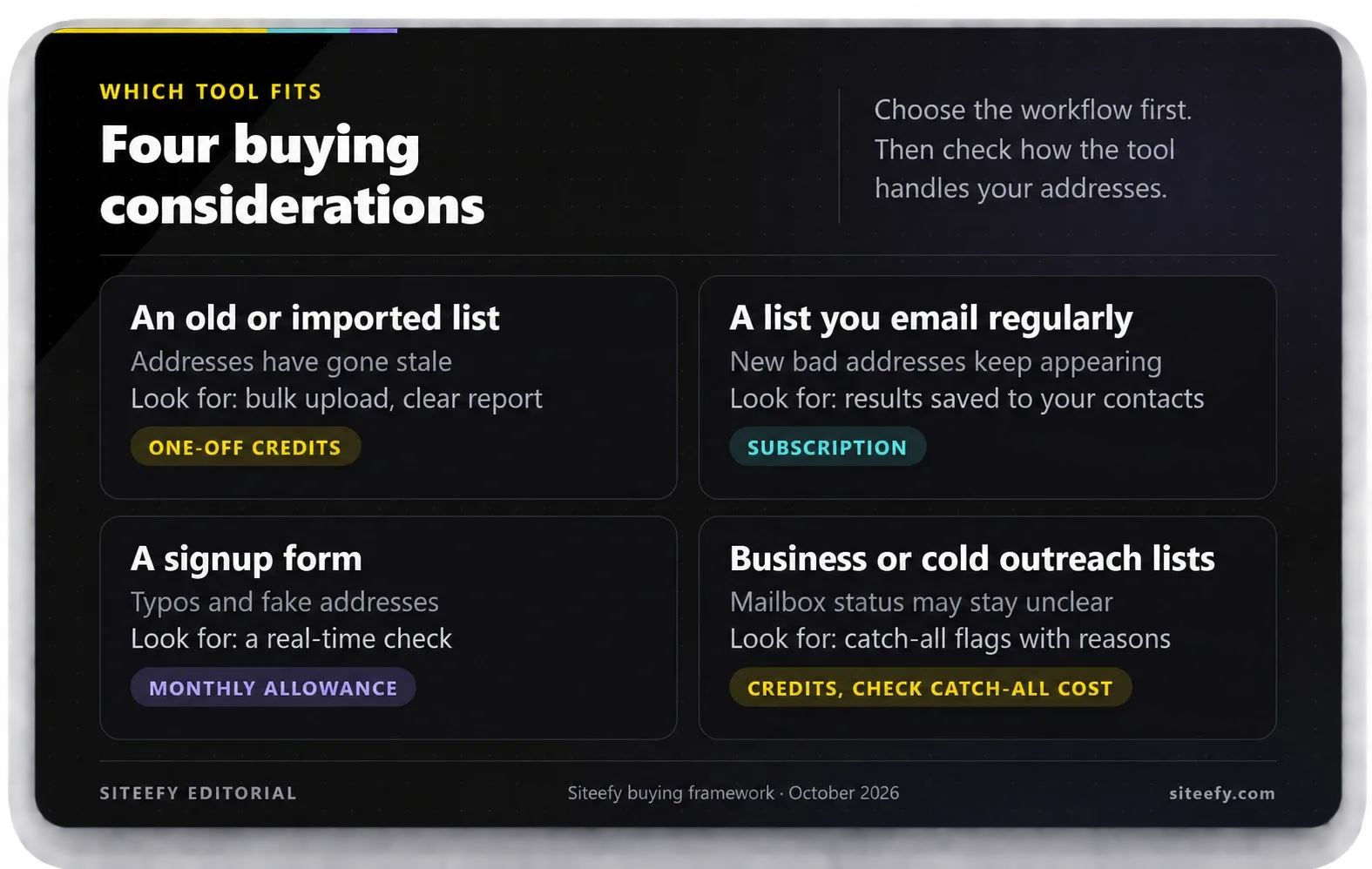
The first decision is when you need to check addresses: during a one-off cleanup, as part of regular list maintenance, or when someone signs up. Business addresses bring an additional consideration, because some company mail servers leave individual inboxes difficult to verify.
An old or imported list
Lists become outdated as people change jobs or abandon inboxes. For example, leads collected at last year's trade show may include addresses that still work but no longer reach the original contact.
For a bulk cleanup, check that the tool can:
- Accept your list without forcing you to split it into several files.
- Return each address with its result and the reason for that result.
- Preserve the fields needed to match results to the right contacts.
- Keep uncertain results separate from clearly invalid addresses.
Keep unsubscribe records intact. A successful address check must never put an unsubscribed contact back into a campaign. The UK's Information Commissioner's Office explains why suppression lists preserve people's opt-out choices.
One-off credits can suit occasional cleanup. Compare the minimum purchase with the number of addresses you actually need to check, and confirm whether unused credits expire. A lower price per address can still mean a larger bill if you have to buy more credits than you will use.
A list you email regularly
For regular campaigns, the question is whether results reach your contact records without repeated manual work. Look for a direct integration with your email marketing platform or CRM, the system that holds your customer records.
Trace one contact through the integration and check that it:
- Updates the correct record.
- Saves the result and a useful reason.
- Preserves the contact's existing unsubscribe status.
An integration that only imports addresses does not complete this process. Confirm that it also returns results to the place where your team uses them.
Match the commitment to your usage. A subscription can suit steady volume. Compare its monthly allowance, unused-credit rules, and total cost with buying credits as needed. Include quiet months when you may pay for checks you do not use.
A bundled platform is another option. Warmy email verification offers bulk list checks and real-time checks through an API, which connects it to your own forms and software, as part of its wider deliverability platform.
The bundle can suit a team that would also use its warm-up and other deliverability features. Confirm the verification allowance for your chosen plan before comparing the cost with a standalone service.
A signup form
A real-time check runs while someone completes a form, so a typo such as gmial.com can be corrected while the person is still on the page. Look for an API or a direct integration with your form.
Test more than a successful check. The form should also handle:
- A clear mistake: explain what needs correcting without losing the rest of the form.
- A delay or unknown result: avoid treating an inconclusive check as proof that the address does not exist.
An address check does not prove that the person signing up controls the inbox. OWASP's guidance on email ownership verification explains the separate confirmation step. For an account signup, accepting the submitted form should not bypass the confirmation required before account activation.
Temporary addresses need a separate decision. They may work now but disappear before someone needs an account-recovery email. Look for a tool that identifies this risk without confusing it with a nonexistent address.
Check what happens when credits run out. Find out whether signup checks stop, continue at an extra charge, or trigger an automatic purchase. Also confirm whether API checks cost the same as bulk checks.
Business and cold outreach lists
The workflow determines when you check an address. The type of address determines how much uncertainty may remain. Business addresses can be difficult to verify whether they arrive through a signup form or an imported file.
For cold email outreach, a list of real companies and employees can still contain addresses that the tool cannot verify. Two results deserve particular attention:
- Catch-all: the company's server accepts checks for names that may not have individual inboxes. Acceptance alone does not confirm the person's mailbox.
- Unknown: the check did not reach a conclusion. A timeout or a server temporarily refusing the request can cause this result.
The largest cleaned list is not necessarily the best result. A tool may retain more contacts because it labels uncertain addresses more generously. Look for reasons you can inspect and a way to keep unresolved addresses separate, rather than treating every retained address as equally reliable.
Billing can also depend on what the service actually does. Identifying a catch-all domain and running an additional check on its addresses are different services. Ask which checks are included, which are optional, and whether extra checks or retries consume more credits.
Test the tool before you pay
Use the requirements above to test a shortlist. Run the same sample of contacts you are entitled to process through each tool, close together in time. Include the address types and collection sources your team actually handles.
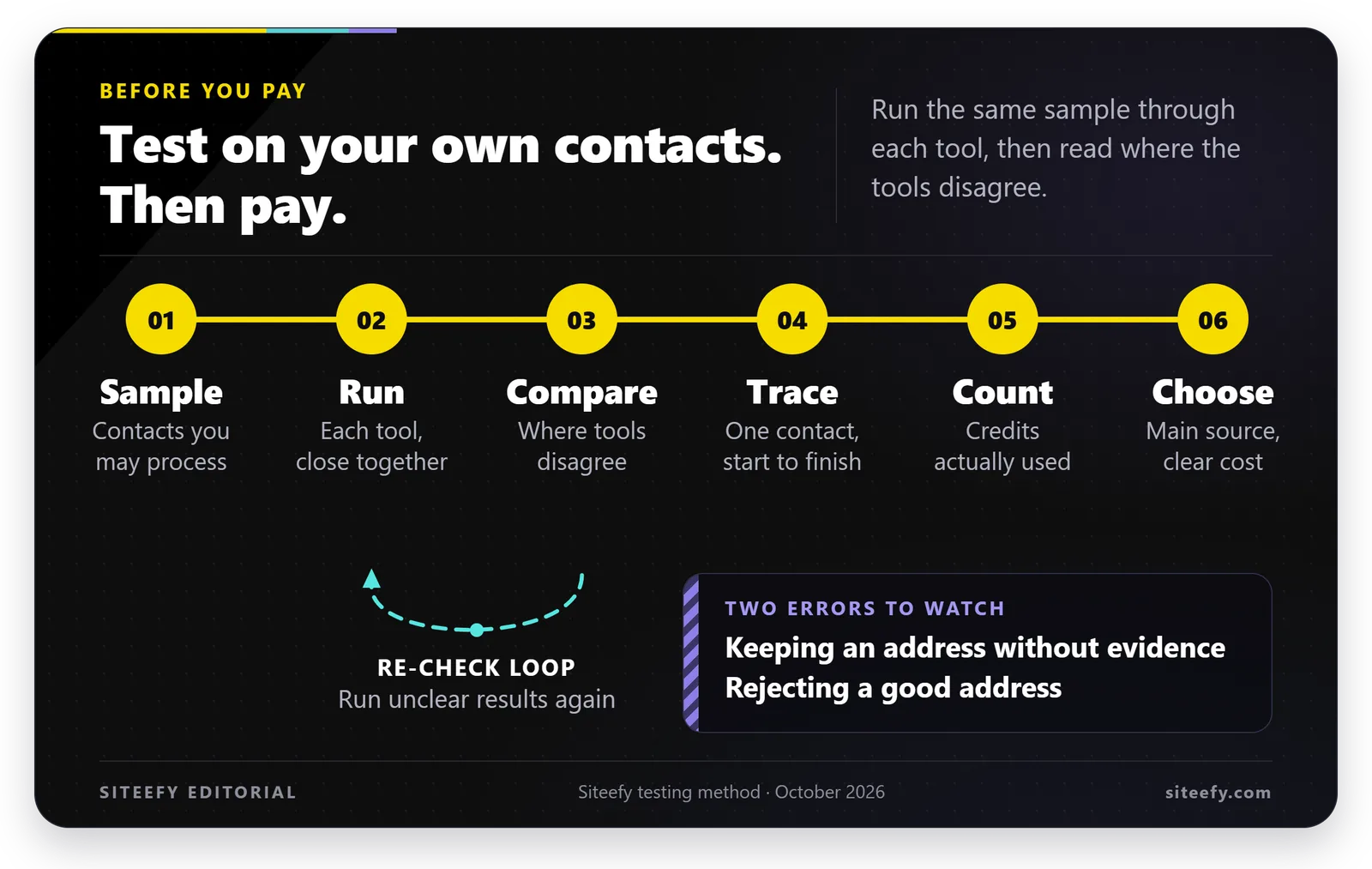
Compare the addresses where tools disagree and read the reasons. Use independent evidence you already have, such as an inbox you control or a recent bounce that specifically reports a missing mailbox. A generic delivery failure does not prove that an address is invalid.
Keep the result files, the time of each check, and the credit balance. Use this checklist to judge whether the tool completes the job:
| What to test | What you need to see |
|---|---|
| A disputed or uncertain result | A specific reason you can investigate, with uncertainty kept when the evidence does not settle it. |
| A contact moving through your workflow | The correct record updated, useful result details kept, and unsubscribe status preserved. |
| A signup check, if you need one | A clear prompt to fix a mistake, sensible handling of delays, and the required inbox-confirmation step preserved. |
| The credits used | Charges for checks, duplicates, and retries that match the provider's stated billing rules. |
Watch for both kinds of error: keeping an address without enough evidence and rejecting a good address. Counting only retained contacts favors a permissive tool; counting only avoided bounces favors one that rejects broadly. Review the reasons behind the decisions. Do not send to known bad addresses just to create a benchmark.
Claims to read carefully
Accuracy needs a method
Ask which addresses were tested, how the results were independently confirmed, and how unknown and catch-all results were counted. Two accuracy percentages cannot rank services fairly if one test excludes difficult addresses while the other includes them.
Verification does not guarantee inbox placement
Verification is only one part of email deliverability; authentication and sender reputation still affect where a message lands. Google's sender guidelines also cover spam complaints and unsubscribing. A reachable address does not establish that its owner wants your email.
Spam trap removal is not a guarantee
Spam traps are addresses used to identify poor sending practices. Spamhaus reports that it still receives messages at spam traps from lists described as cleaned. Treat trap-removal promises cautiously and investigate how the addresses were collected.
Customer data needs clear rules
Contact lists can contain personal data. Before uploading yours, establish who can access it, how long it is kept, how deletion works, and whether it is shared or reused. Check the vendor's data processing terms against your organization's requirements.
Choose from your trial results
Choose the tool that completes your main workflow, gives reasons you can act on, and charges a total you understand. Confirm that it also handles your secondary needs, such as signup checks alongside list cleanup.
The deciding evidence is what happened to your contacts during the trial: whether results were credible, uncertainty remained visible, and the right records were updated without losing unsubscribe choices.