Software changes faster than teams can validate it. This reality forces the testing process to race against rapid development cycles.
Artificial intelligence now reshapes the landscape through a significant reduction in the cost of maintaining complex UI tests. Let us discuss how AI is changing software testing and explore some of the popular automation testing tools.
What AI Is Changing in Software Testing
Artificial intelligence is expanding across many industries, and software testing is one of the areas experiencing noticeable change. A growing number of AI-based tools are being introduced to handle repetitive processes, analyze large volumes of data, and support faster release cycles.
As a result, software testing is shifting from manual script creation toward more autonomous, self-healing, and AI-driven quality assurance processes.
This transformation includes faster no-code test generation through natural language, intelligent maintenance that adapts to UI changes, and predictive analysis used to identify high-risk areas.
The following are some of the testing areas where AI is making a clear impact:
1. Test Creation Is Moving From “Coded Scripts” to “Intent”
Traditional automation depended on engineers to encode precise steps that described the tests. For example, find a selector, click a button, wait for the response, and assert text.
AI-driven tools replace these brittle instructions with high-level intent, such as:
- “Log in as a standard user and purchase an item.”
- “Verify the invoice has the correct totals.”
- “Ensure checkout works on mobile viewports.”
In essence, AI helps translate intent into executable steps, and more importantly, keeps those tests intact when the UI changes. Any UI changes will be automatically applied to the tests (self-healing).
2. Maintenance Is Getting Automated (or at Least Dramatically Reduced)
UI tests often fail for reasons unrelated to actual defects, such as selector changes, layout shifts, and dynamic IDs.
AI systems can use:
- Visual understanding (recognize buttons and form fields by appearance)
- DOM heuristics (fallback selectors, semantic roles)
- Change detection (identify “this element moved” vs “this feature broke”)
Hence, there are fewer failures and less time spent closely monitoring pipelines.
3. Debugging and Triage Are Becoming Faster and More Accurate
Modern AI-assisted platforms can analyze failures, cluster them, and suggest the likely cause. For example:
- “The same failure started after deployment 8f31…”
- “Most likely due to a selector change in navigation.”
- “Backend 500 appears only in the EU region.”
This reduces the “detect → diagnose → assign” loop from hours to minutes.
4. Test Coverage Expands Beyond Functional Checks
AI is increasingly used to generate:
- Exploratory test ideas from product specs or user stories.
- Edge-case inputs (fuzzing-like behavior for forms and APIs).
- Accessibility checks and actionable reports.
- Security findings are integrated into CI workflows.
- Regression testing to validate releases.
Using AI, teams can test more dimensions of quality without treating each dimension as a separate toolchain or skill set.
5. The “QA Role” Is Evolving
Using AI in software testing is not about replacing testers; it’s about changing the highest-leverage work. Testers spend less time scripting repetitive checks and more time on:
- Risk analysis and quality strategy.
- Scenario modeling.
- Monitoring and production validation
- Test data design
- Integrating test signals into release decisions.
Today, strong QA is less about writing Selenium code and more about designing systems that continuously validate product quality.
 Selenium
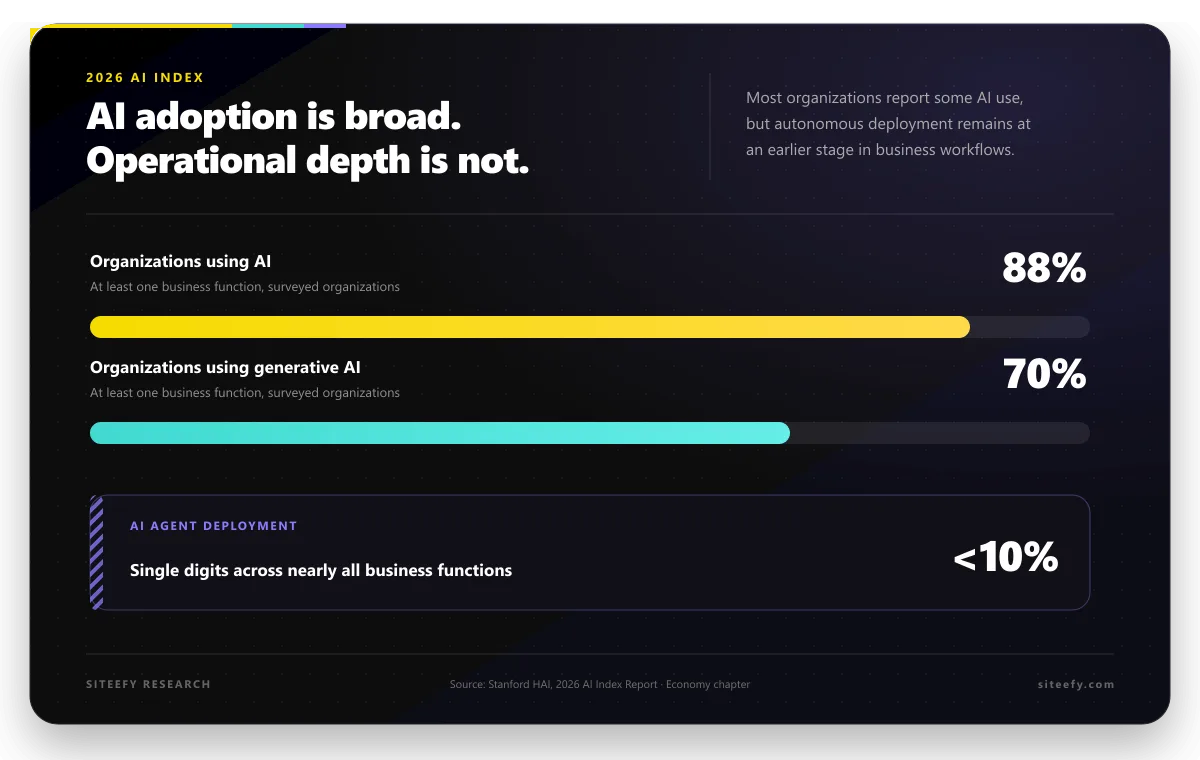
This shift is not theoretical. Industry surveys show that 88% of organizations consider AI a priority in their future testing strategy, and 80% expect it to positively impact testing within the next two years.
Yet adoption is still maturing, as only a small share of teams have fully embedded AI across core testing workflows.
Where AI Testing Still Struggles?
Although AI excels in the areas listed above, there are hard realities:
- Ambiguity in Requirements: When requirements are clearly defined, AI can generate tests. But it can’t decide what the product should do when the requirements are unclear.
- Flaky Environments: AI can reduce flakiness, not completely eliminate unstable test environments.
- Over-Reliance on “auto-fix”: Teams tend to rely too much on “auto-fix,” which can mask real regressions if teams don’t validate the change.
- Compliance and Auditability: Some organizations go for deterministic, traceable test steps; AI workflows need guardrails.
It should be noted that the best results come when AI is used as a copilot with constraints, not an autopilot.
4 AI-Powered Test Automation Tools To Try
|
Tool |
Core AI Strength |
Primary Testing Focus |
Key Advantage |
|
testRigor |
Generative AI & NLP |
Web, Mobile, Desktop |
Uses plain English; requires zero coding to build complex E2E tests. |
|
mabl |
Self-Healing & Visual AI |
Web, API, Mobile |
Low-code platform that automatically adapts tests to UI changes. |
|
Perfecto |
AI Maintenance |
Mobile & Web Cloud |
Massive real-device lab with AI-driven "self-healing" for scripts. |
|
Appvance IQ |
Autonomous Testing |
Web & Mobile |
Uses ML to generate tests from user flows and prioritize high-impact areas. |
|
AI Assistant (Postbot) |
API Development |
Simplifies API test generation and documentation using AI prompts. |
 Postman
Here are tools that represent where automation is heading. The “best” depends on your stack, team skills, and whether your biggest pain is test creation, maintenance, speed, or coverage.
testRigor
testRigor is a generative AI-based test automation tool. This tool offers truly English-based commands, where users create functional, UI, and end-to-end tests based on the user interface. testRigor is a hosted testing solution with multiple third-party interfaces for creating and managing test suites and cases.
The solution supports desktop, web, native, and hybrid mobile apps, mainframe apps, Flutter apps, AI features, graphs, chatbots, and API testing. All tests may be done in parallel with a single click.
testRigor does not support XPath/CSS locators for element identification. Instead, it works in an AI context to recognize elements, and hence, even mainframe testing is possible using testRigor.
👍 Pros:
- testRigor is the leading tool for authoring tests in plain English. Manual testers can become automation engineers in days, as there is zero coding required
- Test creation is way faster than Selenium or Playwright
- Supports easy testing of ERP systems
- Uses AI to simplify test creation (through generative AI), streamline test execution, and reduce test maintenance time
- Provides an extensive list of features to test various modern-day applications. Its advanced AI lets you test complex scenarios such as Captcha resolution, maps / GIS, email, SMS, 2FA, audio, video, phone calls, file, accessibility testing, exploratory testing, and many more
 Playwright
mabl
Mabl is an AI-powered automation tool using a mix of smart tools and a simplified design. Built alongside today’s fast-moving release cycles, it fits right into continuous integration workflows. The tool uses a point-and-click setup for building checks.
Learning from changes, the system automatically adapts tests, reducing manual updates later. It offers pattern recognition to track app behavior, resulting in less hand-tuning.
Users can perform robust testing across all popular browsers simultaneously by switching to Mabl. This removes the barrier between graphic design, user experience testing, and performance testing.
In the long run, this minimizes the physical effort, the infrastructure required for hosting, and test case management for automated testing by handling it all in the cloud.
👍 Pros:
- AI-powered test generation, expedited test execution, reduced test maintenance, and test analysis
- Good for bridging the gap between manual testers and automation engineers, allowing the entire team to contribute to the same suite
- It is developer-friendly and low-code with its CLI and IDE integrations; it’s one of the few codeless tools that developers actually enjoy using alongside QA
- Offers many powerful integrations for you to build your testing ecosystem
Perfecto
It is a cloud-based, automated, and continuous testing solution for mobile and web-based applications. It supports a wide range of operating systems, browsers, and mobile devices and is available for use in the development of web apps and conducting mobile app testing.
With Perfecto, you can test on virtual devices (Android Emulators and iOS Simulators) alongside real ones.
Its AI self-healing feature enables test scripts to run continuously without maintenance. Perfecto lets you simulate real user conditions, including network coverage, device location, and even conflicting apps.
👍 Pros:
- Detailed analysis and reporting of test data.
- Capabilities for test maintenance (self-healing) driven by AI.
- It is endlessly possible to scale up the execution among several Android devices simultaneously.
- Great for global teams that need to test across thousands of real devices and complex native device sensors (like scanning a QR code or using FaceID) without writing a single line of code.
Postman
Postman is a popular and versatile API client that goes beyond just making HTTP requests. It simplifies the process of developing, testing, and documenting APIs. It offers you a user-friendly interface to send HTTP requests and analyze responses.
Therefore, it is a valuable tool for developers and testers. Postman supports various types of testing, including functional, integration, and performance testing. It also provides good features such as automated testing, mocking, and API documentation.
👍 Pros:
- Ideal for developers and testers.
- Requests are created visually with a user-friendly interface.
- Enables interactive exploration and debugging of APIs for users.
- It can be used to develop advanced automation capabilities using scripting within the tool.
Appvance IQ
Appvance IQ is an autonomous testing platform that uses AI and Machine Learning (ML) to create and execute test scripts. It can be used for both web and mobile applications and supports various types of testing, including functional, performance, and security testing.
The platform uses a model-based testing approach to generate test scripts from the application’s user flows. Appvance IQ can also self-heal test scripts by automatically identifying and fixing issues, making it a valuable tool for continuous testing and integration.
👍 Pros:
- Excellent for high-frequency CI/CD environments requiring fast feedback.
- Usage-driven testing prioritizes tests based on their impact on users.
- In-depth analytics and debugging with real-time performance metrics.
Summary
AI testing is redefining quality assurance. Faster test creation, self-maintaining automation, predictive defect detection, and continuous quality feedback are no longer aspirational. They're operational realities for organizations that embrace intelligent automation.
The future of QA lies in platforms that combine human insight with AI. The tools discussed in this article are not replacing human testers but amplifying their capabilities, shifting focus from repetitive maintenance to critical thinking and complex edge-case identification.