
01
401.6M
1,489,396,284
217,654,258
active websites
Here's what our growth model calculates - by the day, hour, minute, and second.
Estimated net growth per day
639,769
net increase in the total number of websites worldwide every 24 hours
Per Hour
26,657
Estimated net increase each hour.
Per Minute
444
Estimated net increase each minute.
Per Second
7
Estimated net increase each second.
While You Read
4,440+
Estimated increase during a typical 10-minute read.
See how the estimate is calculated and how it changes month to month in our daily website growth analysis.
This yearly benchmark shows how large the online audience is when we talk about website growth.
6.00B
People Online (2025)
In 2025, about 6.0 billion people were online worldwide.
74%
Population Online (2025)
In 2025, about 74% of the world's population was online. That was up from 5.8 billion people online in 2024.
Based on the ITU yearly benchmark for 2025.
See the full online population analysis for growth over time and the share of the world that is online.
Quick reference
401.6M
3.98B
5.8x
41.2%
49.6%
google.com
1990
The headline count includes every hostname the survey can reach, parked domains included.
How many websites are on the Internet?
While the exact number of websites keeps changing, there are currently about 1,489,396,284 sites on the world wide web according to the latest available data, compared to 1,247,534,188 in June 2025.
The milestone of 1 billion websites was reached in September 2014 followed by a bounce back to under 1 billion for one and half years.
The total number of websites on the Internet reached 1 billion again only in March 2016.
Today this number continues to change as you read this article.
Where websites are hosted: As of July 2026, the United States is used by 33.0% of websites whose server location is known. The next-largest location is Germany at 14.7%.
This shows where servers are located, not where the website owner lives. Our guide to the four types of web hosting explains what sits behind those servers.
Domain names: There are approximately 401.6 million registered domain names worldwide as of Q2 2026. A domain is a website address, but one website can use several domains and many registered domains do not contain an active website.
See how many domains there are for the current total, the most common extensions, and the historical trend.
Historical growth of websites since 2008, showing January snapshots by year with total websites, active websites, and active share. Year-to-year jumps in the earliest rows are large because the survey's coverage and the behavior of hosting systems changed over this period. Read them as movements in what the survey could see, not only as websites being created or shut down.
| Year | All Websites | Active Websites | Active % |
|---|---|---|---|
| January 2026 | 1,376,952,390 | 207,532,573 | 15.07% |
| January 2025 | 1,161,445,625 | 194,973,562 | 16.79% |
| January 2024 | 1,079,154,539 | 192,375,760 | 17.83% |
| January 2023 | 1,073,166,232 | 198,834,218 | 18.52% |
| January 2022 | 1,036,099,382 | 197,220,000 | 19.04% |
| January 2021 | 1,025,456,000 | 187,637,000 | 18.3% |
| January 2020 | 1,030,111,000 | 189,021,000 | 18.35% |
| January 2019 | 1,038,563,000 | 192,980,000 | 18.58% |
| January 2018 | 1,060,403,000 | 195,540,000 | 18.44% |
| January 2017 | 1,064,660,000 | 174,791,000 | 16.42% |
| January 2016 | 966,811,000 | 170,047,000 | 17.59% |
| January 2015 | 860,926,000 | 167,659,000 | 19.47% |
| January 2014 | 860,467,000 | 180,468,000 | 20.98% |
| January 2013 | 672,985,000 | 182,499,000 | 27.12% |
| January 2012 | 646,987,000 | 155,190,000 | 23.99% |
| January 2011 | 547,211,000 | 255,810,000 | 46.76% |
| January 2010 | 255,839,000 | 205,691,000 | 80.4% |
| January 2009 | 238,027,000 | 185,300,000 | 77.86% |
| January 2008 | 173,123,000 | 75,959,000 | 43.88% |
Source: Netcraft Web Server Survey
Websites Milestone
The milestone of 1 billion websites was reached in September 2014
Path to 1 billion websites
Web scale crossed a new threshold
Reached in
Growth milestones
First billion mark
Most of the websites in the total are not serving content to anybody.
Although there are over a billion websites out there, not all of them are active.
Only about 15% of all websites in the world are active and being used in some fashion.
The remaining 85% of all websites are not active. Instead, most of them are parked domains or have a similar function.
As of June 2026, there are 217,654,258 active websites and 1,271,742,026 inactive websites in the World.
In other words, there are about 5.8 inactive websites for every active one.
More Inactive Sites
Inactive sites outnumber active 5.8 to 1
Active vs Inactive Websites
Distribution of active and inactive websites worldwide
Years of Continuous Data
Tracking active vs. inactive websites since 2008.
One of the web's most stable website benchmarks.
Nobody can count every page. The public benchmarks measure indexed pages instead.
Okay, we already know how many websites are on the Internet. Now, what about the web pages?
How many pages are on the Internet?
As you probably know, a webpage is something different from a website.
Web pages are compound parts of websites and sites usually consist of one or more web pages.
Currently, the absolute number of all existing web pages on the Internet is unknown.
The newest public indexed-page benchmark currently stands at at least 3.98 billion indexed pages as of January 15, 2025.
That figure is not a count of all pages on the web. It is a benchmark for publicly indexed pages, which is why it sits below the broader number of pages that likely exist online.
In other words, a website count and an indexed-page count are related, but they are not the same thing.
Those pages are also getting heavier every year. Our website speed statistics show how many of them still load quickly enough for real visitors.
Latest public indexed-page benchmark (January 15, 2025)
English still leads the web, but it now accounts for less than half of all websites rather than an overwhelming majority.
Current language-share benchmark.
Most Popular
English
Dominates the web as the primary language for websites worldwide
49.6%
of all websites
Spanish
6.1%
German
5.9%
Japanese
4.9%
French
4.5%
While over 7,000 living languages exist worldwide, less than 200 languages have a digital presence on the Internet
Google publishes a page index, never a website count.
There is no official public number for how many websites are in Google's index.
That is partly because search engines work on individual web pages, not on websites as a whole. One website can contribute a single indexed page or several million.
The nearest public measure is the indexed-page benchmark in the webpages section above. It counts pages, so it cannot be converted into a number of websites.
Google has also never published how many distinct websites it has crawled, indexed, or dropped, and a website can be indexed for some pages while others are excluded.
So the honest answer is that Google's exact page and website totals are not publicly known.
One decision at CERN in 1993 removed the royalty barrier and the count never slowed.
All things considered, the growth of websites has been quite remarkable thanks in large part to a decision taken on April 30th, 1993 by CERN.
This decision made the world wide web available on a basis that was free of royalties.
In essence, it became a public domain which allowed people around the world to create their own websites.
While the growth of the web has been explosive, one of the biggest jumps occurred in 2013 when the web grew by almost a third.
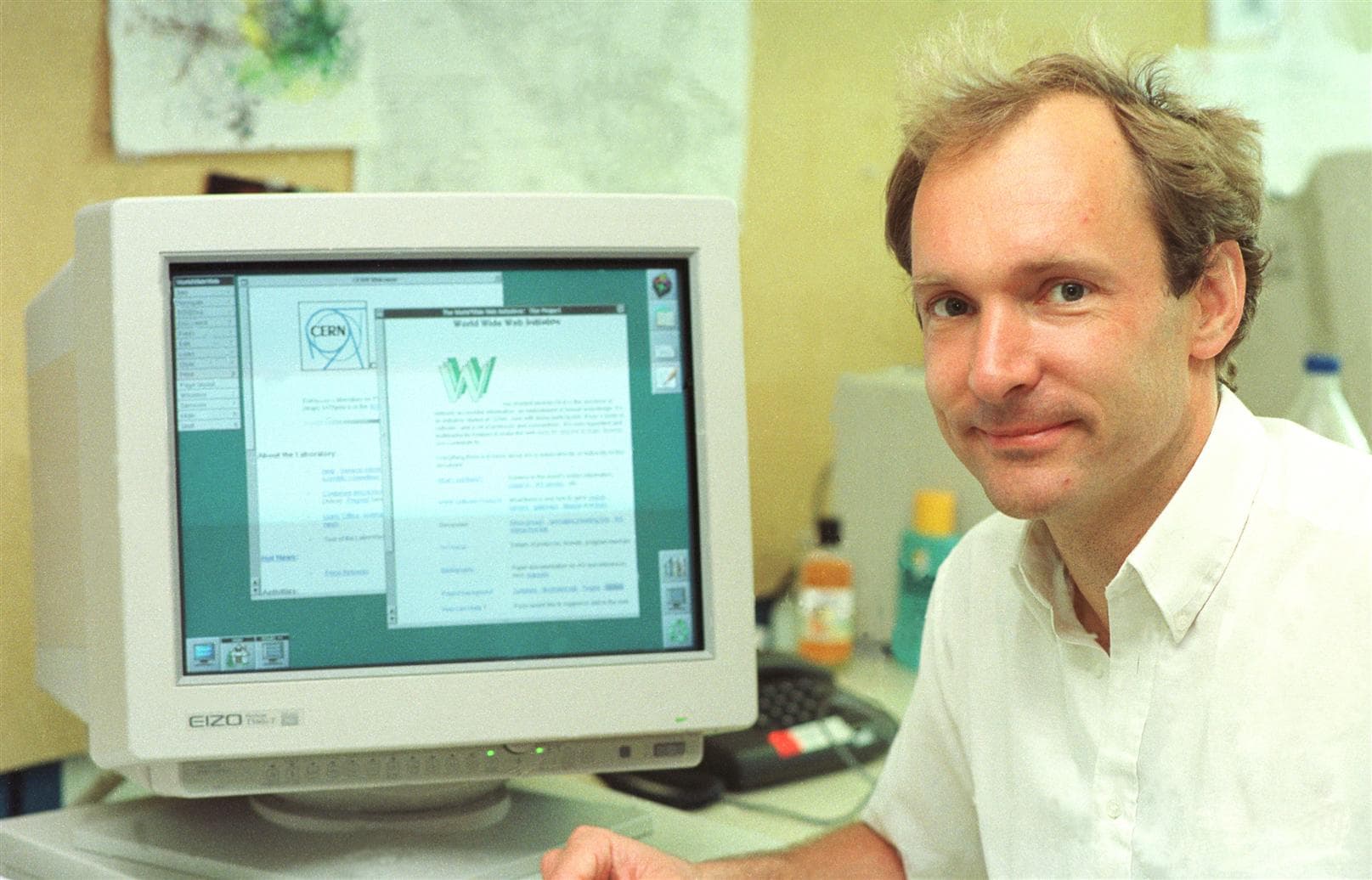
The world wide web is credited to Tim Berners-Lee, who began it in March 1989
IMDB started as a "actresses with beautiful eyes" list on Usenet in 1990, before becoming the movie database we know today.
The first web banner ad appeared in 1994, and about 44% of the people who saw it clicked on it - a number that feels almost impossible today.
WordPress remains the most widely used content management system, and its rise helped lower the barrier to building websites at scale across the web.
41.2%
of all websites use WordPress
WordPress remains the most widely used content management system. Its market share, competitors, plugins, themes, and ecommerce ecosystem are covered on the dedicated WordPress statistics page.
1989
The World Wide Web
The World Wide Web was created by Tim Berners-Lee, a British scientist working at CERN in Switzerland. His revolutionary invention changed the world forever.
Creator
Sir Tim Berners-Lee
British scientist and inventor
Location
CERN, Switzerland
European Organization for Nuclear Research
First Website
nxoc01.cern.ch
First online in late 1990, later reached at info.cern.ch
CERN's restored version of that page is still readable online today. Our first website guide shows what it contained, its original address, and why both 1990 and 1991 appear in accounts of the Web's birth.
A better way to understand the internet's size is to look at several current benchmarks together.
How big is the internet today?
There is no single perfect live number for the size of the internet because the internet is not just one thing. It includes websites, web pages, domains, apps, files, users, and constant traffic moving between them.
A clearer way to think about it is to look at the biggest benchmarks side by side: 1,489,396,284 websites (June 2026), 217,654,258 active websites, 3.98 billion publicly indexed pages (January 15, 2025), 401.6 million registered domains (Q2 2026), and 6,000,000,000 people online (2025).
Each of those numbers measures a different part of the internet. Website totals show overall scale, active-site totals show how much of the web is actually being used, domain registrations show naming scale, indexed-page benchmarks show searchable scale, and internet-user totals show the size of the connected audience.
That is why no single number can fully describe how big the internet is. The honest answer is that it is enormous, always changing, and better understood through several current benchmarks instead of one headline figure.
That total includes everything from simple business sites and blogs to stores, communities, and web applications. The types of websites guide explains the main categories with real examples, and the website ideas guide shows 20 of those models operating today.
For a wider view of users, traffic, data, and infrastructure, see our internet statistics.
Most visited website: google.com ranks first in the latest worldwide traffic snapshot for June 2026.
Traffic rankings change every month. See the full most-visited websites ranking for the current top ten, traffic estimates, and recent movement.
4 entries · Mixed update cadence
| Section | Type | Source | Date | Note |
|---|---|---|---|---|
| 01Total websites, active websites, growth estimate, yearly table update | Latest monthly benchmark | Netcraft Web Server Survey | June 2026 | Primary monthly source used for the total number of websites, active websites, and the net-growth model. |
| 02Registered domains | Periodic metric | Verisign Domain Name Industry Brief | Q2 2026 | Quarterly domain-registration benchmark used for the current domain count. |
| 03Net website growth per day | Latest monthly benchmark | Derived from net-growth model | June 2026 | Calculated by spreading the smoothed monthly net-change estimate across the days in the month. |
| 04Indexed pages / websites on Google | Dated context | WorldWideWebSize | Frozen since January 15, 2025 | Previously live benchmark, now frozen because the upstream source is no longer publishing new data. Retained as dated context. |
4 parts · Netcraft-based
01 - Total count
The headline total comes from Netcraft's monthly Web Server Survey. It counts hostnames found across the web, including active websites, parked domains, and default server pages.
02 - Active count
Netcraft also publishes a smaller active-site benchmark intended to represent sites serving distinct content. Siteefy uses the two figures separately rather than treating every detected hostname as a maintained website.
03 - Daily growth
The daily figure is an estimate of net growth, not a count of every new launch. It uses the latest 12 monthly changes, limits the effect of unusual swings, gives more recent months more weight, and converts the result to a daily average.
04 - Limits
The survey and the resulting estimate can move when hosting systems, survey coverage, or website behavior changes. The figures are best read as current benchmarks, not exact live counters.